
You likely entered your profession to provide value, yet standard sales techniques often leave you feeling disconnected from your integrity. It’s a common struggle; you want to grow, but the physical tension of "closing" makes you want to retreat. If you’ve ever wondered how to sell without being pushy, the answer lies in a fundamental shift of your internal philosophy.
You deserve a process that feels like a natural conversation. We’ll explore how to align your values with a friction-free discovery process. You’ll see how the Natural Selling approach uses a Natural Selling Conversational Dialogue to remove barriers. We’ll move from standard pressure to a place of genuine influence, helping you connect with potential partners through ease and clarity.
Key Takeaways
- Discover how to sell without being pushy by closing the gap between your desire for a result and your potential partner’s readiness to buy.
- Understand the psychological mechanics of resistance and how to replace standard sales techniques with a focus on ease and human connection.
- Utilize the Natural Selling Conversational Dialogue to facilitate a journey of discovery that relies on influence rather than the pressure to persuade.
- Achieve internal peace by aligning your professional actions with your core values, removing the ethical friction that often leads to burnout.
The ‘Pushy’ Problem: Why Standard Sales Techniques Feel Wrong
Most practitioners feel a deep sense of unease when following standard sales techniques. This discomfort isn’t a lack of ambition; it’s an alarm bell signaling a lack of internal alignment.
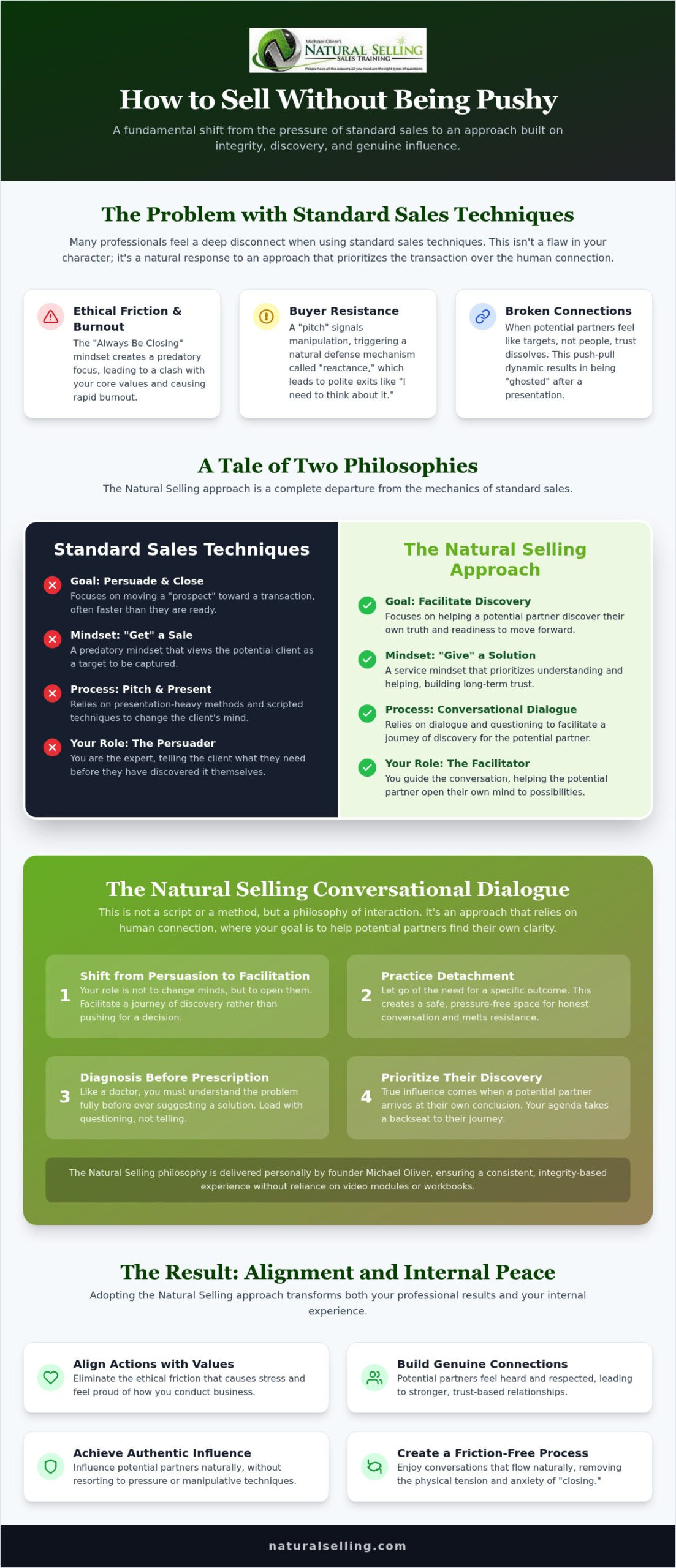
Pushiness is an attempt to move a potential partner faster than their own internal logic allows. When you try to pull someone toward a solution before they’ve discovered the depth of their own need, you inadvertently trigger resistance. Learning how to sell without being pushy begins with recognizing that standard sales models are often presentation-heavy and closing-focused. They prioritize the transaction over the human being.
The Ethical Friction of ‘Always Be Closing’
The "Always Be Closing" mantra creates a predatory mindset that potential clients can sense instantly. It shifts the focus from service to capture.
This pressure ruins long-term relationship potential because trust is fragile; once a potential partner feels like a target rather than a person, the connection dissolves. If your intent is to "get" a sale rather than "give" a solution, the resulting ethical friction leads to rapid burnout. You’re left faking enthusiasm while your integrity quietly protests.
The Symptoms of a Pressure-Based Approach
If you’ve ever experienced a potential client "ghosting" you after what felt like a perfect presentation, you’ve felt the effects of the push-pull dynamic. Often, the dreaded "I need to think about it" objection is just a polite exit strategy to escape perceived pressure.
Internally, you might feel a physical knot in your stomach before a call. These symptoms are not flaws in your character. They’re natural responses to a system that treats human interaction like a mechanical process of persuasion. If that knot feels familiar, understanding how to build an effective sales philosophy grounded in human connection can help you replace that discomfort with genuine confidence.
The Mechanics of Buyer Resistance: Why Your ‘Pitch’ Triggers a ‘No’
Resistance is a physiological response, not just a verbal "no." In psychology, this is known as "reactance." It’s the brain’s natural defense against perceived manipulation. When you begin a "pitch," you signal that the potential partner’s unique needs are no longer the priority.
This is why learning how to sell without being pushy is about understanding human dynamics rather than memorizing scripts. Modern buyers are hyper-sensitive to sales techniques; they can sense a scripted pivot from a mile away. For those looking to navigate these modern challenges with the help of advanced tools, check out AI Powered Network Marketing.
Logical resistance usually involves facts or budgets, but emotional resistance is far more powerful. It’s the "gut feeling" that something is off. If the logic is sound but the feeling is wrong, the answer will always be "no." To move forward, you must address the emotional climate of the conversation before the technical details. This is precisely why a human centric sales approach focuses on your internal intention first — because people respond to what you mean, not just what you say.
The Trigger Point: When a Conversation Turns into a Sale
The moment you shift from listening to "telling," the energy changes. You might notice a potential partner’s body language tighten or their eyes glaze over. This is often the "Expert Trap" in action.
By being too helpful too early, you assume you know the solution before they’ve fully explored the problem. These assumptions create interpersonal barriers that stop the flow of dialogue and trigger a defensive "no."
Removing the Barriers to Connection
True influence requires a state of detachment. If you let go of the need for a specific outcome, you create a safe space for the potential partner to be honest. When your intent is purely to help them discover their own truth, resistance melts away.
This internal congruence is the foundation of the Natural Selling philosophy. By focusing on the human element, you move from a state of friction to a state of flow. Knowing how to sell without being pushy means you prioritize their discovery over your own agenda.
Shifting from Persuasion to Facilitation: A New Sales Philosophy
Most people asking how to sell without being pushy are looking for a way to soften their "pitch." However, true ease comes from eliminating the pitch entirely.
The Natural Selling approach shifts your role from a persuader to a facilitator. Facilitation is the act of helping a potential partner discover for themselves if a problem actually exists. While standard sales techniques focus on changing minds, facilitation focuses on opening them. This process relies on human connection rather than video modules or workbooks. The goal shifts from getting a check to uncovering the truth. Building an effective sales philosophy around this facilitative mindset is what separates practitioners who thrive from those who burn out.
The Facilitator Mindset
If you believe your core job is to help, you can never be pushy. Consider the doctor-patient relationship; a doctor doesn’t "close" a patient. They diagnose first. In this integrity-based philosophy, diagnosis must always precede the prescription. Michael Oliver is the only trainer for this program, ensuring you learn this mindset directly from the source. He teaches that you handle a "No" with the same grace as a "Yes." If your solution isn’t a fit, then a "No" is the honest outcome.
Flow Over Friction: The Natural Selling Cadence
Natural Selling Conversational Dialogue relies on a deliberate rhythm. It uses pauses and reflection to mimic the cadence of a thoughtful conversation. You use a conditional "If-Then" logic of discovery. If they have a problem, and if they want to solve it, then you talk solutions. This aligns your sales rhythm with the potential client’s natural decision-making cycle. It’s a direct, human-to-human process that bypasses the need for impersonal workbooks. This flow removes the friction inherent in competitor frameworks.
Mastering the Art of Questioning: How to Lead Without Pushing
If you’ve ever felt a conversation stall, it’s likely because your questions were designed to lead a potential client to your solution rather than their own truth.
Mastering how to sell without being pushy requires a specific hierarchy of inquiry. You move from surface-level data to deep-seated emotional impact. Unlike standard sales techniques that use leading questions to persuade, this approach focuses on discovery. Avoid asking "Why," as it often feels aggressive and triggers defensiveness. Instead, use "What" or "How" to encourage reflection. This allows you to exercise genuine influence by helping them articulate the problem, the cost of the status quo, and their ideal solution.
Crafting Questions that Invite Discovery
Natural Selling Conversational Dialogue follows a specific progression to help potential partners uncover their own needs:
- Broad Questions: Open-ended inquiries to define the current environment.
- Depth Questions: Uncovering the personal or business cost of the status quo.
- Future-State Questions: Allowing the potential client to describe their own ideal solution.
When you listen for what isn’t being said, you hear the underlying values that drive their decisions. Learning how to sell without being pushy is ultimately about becoming a master of the question.
The Power of the Pause
Silence is your most effective tool. When a potential partner is thinking, resist the urge to fill the gap. The person asking the questions is the one facilitating the journey. If you provide the space, they’ll provide the clarity.
This is a skill honed through direct mentorship with Michael Oliver, who is the only trainer for this program, rather than through impersonal video modules. To master this nuance, explore the Natural Selling Course where you’ll learn to lead through insight.
Aligning Your Inner Beliefs with the Natural Selling Process
You cannot successfully adopt a non-pressure approach if your underlying philosophy remains rooted in the desire to capture a result. If your intent is to "get," then no amount of soft language will mask that energy.
True mastery of how to sell without being pushy requires identifying your internal "Sales Saboteurs." These are the subconscious beliefs that make you feel like an intruder when asking for a commitment. Soulful Selling occurs when your personal values and professional revenue are in perfect congruence. You stop being a person who "sells" and start being a trusted advisor who facilitates clarity.
Overcoming the Fear of Rejection
Rejection only stings when you are attached to a specific outcome. In the Natural Selling approach, you reframe a "No" as a successful discovery. If the solution isn’t a fit, the "No" is the truth. Philosophical alignment removes the personal weight of a lost deal. You find the relief of being your authentic self in every interaction. Either the connection is there, or it isn’t. Both outcomes are acceptable because both are honest. This internal peace is the cornerstone of how to sell without being pushy.
Next Steps: Mastering Natural Selling
Moving from theory to mastery requires a structured path. This isn’t about passive learning through video modules or workbooks. It’s about a deep psychological shift. Michael Oliver, the only trainer for this approach, guides you through this transformation personally. You join a community of ethical professionals who value integrity over aggression. Explore Natural Selling to transform your sales approach today.
Embracing a New Way of Being
The shift from standard sales techniques to genuine influence isn’t just about changing your words; it’s about changing your intent. By replacing the pressure to persuade with the curiosity of Natural Selling Conversational Dialogue, you transform the commercial exchange into a human connection. You’ve discovered that knowing how to sell without being pushy is a matter of internal alignment. If your actions match your values, the friction of the "close" simply disappears.
For over 29 years, Michael Oliver has helped practitioners find peace in their professional roles. As the author of the definitive text on this approach and the only trainer for the program, he prioritizes human dynamics over impersonal video modules. Your success doesn’t require a mask. It requires your authentic self. Take the first step toward friction-free growth with our Natural Selling Philosophy Training. You are ready to lead with integrity.
Frequently Asked Questions
Is it really possible to hit high sales targets without being pushy?
Yes, it’s entirely possible to exceed your targets by focusing on the removal of interpersonal friction. When you learn how to sell without being pushy, your conversion rates often rise because potential partners feel safe enough to be honest. High targets are met through the depth of connection rather than the volume of pressure you apply to the situation.
What should I do if a potential client says they need to ‘think about it’?
If a potential client needs to reflect, honor that space instead of using a standard sales technique. You might ask, "When you say you need to think about it, what specifically is it that you feel needs more clarity?" This invites them to reveal the underlying concern that hasn’t been addressed yet, allowing the dialogue to continue with ease.
How do I transition from a friendly conversation to actually asking for the sale?
In this approach, there is no jarring jump from conversation to closing. If the Natural Selling Conversational Dialogue has been thorough, the transition is a logical conclusion. You simply ask if they feel the solution matches the problem they just described. If the alignment exists, the decision is a mutual realization rather than a forced request for a check.
Can the Natural Selling philosophy work in high-ticket B2B sales?
This approach is particularly effective in high-ticket B2B environments where trust is essential. Michael Oliver, the only trainer for this program, teaches you to navigate these human dynamics without scripts. If you try to persuade stakeholders using standard sales techniques, you trigger resistance. Natural Selling ensures every partner feels understood throughout the long decision-making cycle.
What is the difference between consultative selling and Natural Selling?
Consultative selling often functions as a "softer" way to lead someone to a pre-determined close. In contrast, Natural Selling is about total detachment from the outcome. One seeks to guide; the other seeks to facilitate. If you are facilitating, you are helping the potential partner discover their own truth, whether that leads to a sale or a realization that it’s not a fit.
How do I handle price resistance without using standard sales scripts?
Price resistance is usually a signal that the value of the solution hasn’t been fully discovered. Instead of a script, return to the "Impact" phase of the conversation. If the cost of the problem is clear, the price of the solution becomes a secondary detail. You facilitate a conversation about the cost of doing nothing versus the value of the desired future state.
What if my manager or company demands that I use high-pressure techniques?
This is a common ethical dilemma. Often, managers demand high-pressure techniques because they believe it’s the only way to drive numbers. However, if you consistently hit your targets by learning how to sell without being pushy, the results usually speak for themselves. You demonstrate that influence and integrity lead to higher quality partners and fewer cancellations than aggressive persuasion ever could.